The modern vehicle is no longer just a mechanical machine; it is a complex, mobile data center. At the heart of this transformation is the electrical distribution system (EDS). For engineers and procurement managers at global automotive brands, selecting a SOAR custom car wiring harness is a decision that impacts vehicle safety, signal integrity, and long-term reliability.
The shift toward Electric Vehicles (EVs) and Advanced Driver Assistance Systems (ADAS) has increased the density and complexity of wiring architectures. A single failure in a sub-harness can lead to critical system outages or costly recalls. Therefore, evaluating a custom solution requires a deep dive into material science, manufacturing tolerances, and rigorous testing protocols.

Technical Architecture of a SOAR Custom Car Wiring Harness
A professional-grade wiring harness is far more than a bundle of copper. It is an engineered assembly designed to withstand the harshest environments on earth—from the sub-zero temperatures of arctic testing to the extreme heat of an engine bay.
When specifying a SOAR custom car wiring harness, the engineering focus typically begins with the conductor and insulation. Modern automotive applications prioritize weight reduction and signal clarity. High-purity oxygen-free copper (OFC) remains the industry standard for conductivity, while insulation materials like Cross-linked Polyethylene (XLPE) or Polyvinyl Chloride (PVC) are selected based on their thermal rating and resistance to oils, fuels, and abrasion.
Key Component Specification:
- Conductors: Multi-strand copper for flexibility and vibration resistance.
- Insulation: Specialized coatings rated for Class T4 (-40°C to +150°C) environments.
- Connectors: Integration with Tier 1 connector brands (e.g., TE Connectivity, Molex, Deutsch) to ensure waterproof sealing (IP67/IP69K).
- Shielding: Braided or foil EMI/RFI shielding for high-speed data lines used in infotainment and sensor arrays.
Critical Performance Metrics in Automotive Environments
For global automotive brands, a wiring harness must meet global compliance standards. The "Commercial" intent behind selecting a supplier like SOAR often hinges on their ability to match specific performance benchmarks.
- Mechanical Durability: Harnesses must endure constant vibration (G-forces) without terminal back-out or insulation chaffing. This is achieved through precise crimp force monitoring during the manufacturing process.
- Chemical Resistance: Automotive fluids are corrosive. Custom harnesses must be tested against battery acid, brake fluid, and engine coolants.
- Signal Integrity: In the era of CAN bus, LIN bus, and Automotive Ethernet, maintaining impedance control is vital. A custom harness must prevent "cross-talk" between high-voltage power lines and low-voltage sensor lines.
| Performance Factor |
Standard Requirement |
SOAR Solution Capability |
| Operating Temp |
-40°C to +125°C (Standard) |
Up to +150°C with XLPE/ETFE |
| Waterproofing |
IP67 |
IP69K (High-pressure steam jet resistance) |
| Flame Retardancy |
UL 94 V-0 |
Low-smoke, zero-halogen (LSZH) options |
| Compliance |
ISO 9001 |
IATF 16949:2016 (Automotive Quality Management) |
Material Selection: Balancing Cost and Performance
When evaluating a SOAR custom car wiring harness, the selection of materials is the primary cost driver. Engineering teams must balance the "over-engineering" of a component against the risk of field failure.
For interior cabin wiring, standard PVC-insulated harnesses are often sufficient and cost-effective. However, for "under-the-hood" or "chassis-mounted" applications, engineers often pivot to specialized polymers. For example, if a harness is routed near the exhaust manifold, heat-reflective aluminized fiberglass sleeving is added to the custom build.
Furthermore, the choice of terminals—gold-plated versus tin-plated—is dictated by the low-voltage requirements of modern ECUs. Gold plating is preferred for sensor signals where even slight oxidation could lead to a "Check Engine" light or ADAS sensor malfunction.
Manufacturing and Quality Assurance (EEAT Logic)
The reliability of a wiring harness is only as good as the process used to build it. In a professional manufacturing environment, SOAR utilizes automated wire cutting, stripping, and crimping machines to eliminate human error.
Terminal Crimp Analysis: This is a non-negotiable step in automotive manufacturing. Cross-sectional analysis of the crimp ensures that the gas-tight seal between the wire and the terminal is perfect, preventing oxidation at the contact point.
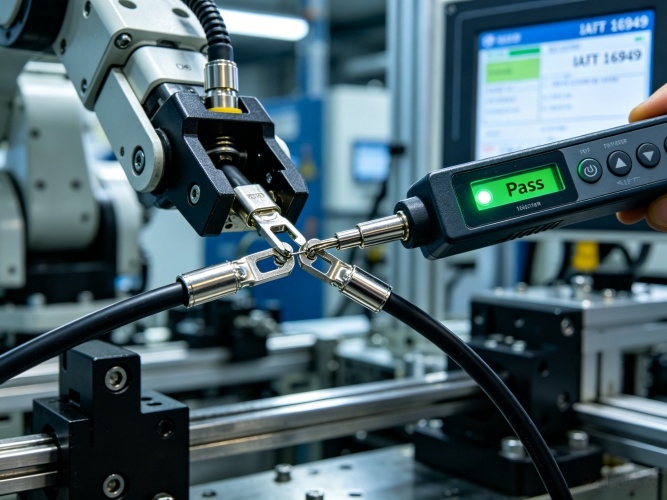
Electrical Continuity Testing: 100% of custom harnesses must undergo automated circuit testing. This includes high-pot testing (dielectric withstanding voltage) to ensure there are no microscopic breeches in the insulation that could lead to a short circuit under high-load conditions.
Integrating SOAR Solutions into Global OEM Supply Chains
Global automotive brands require more than just a component; they require a partner capable of scaling from prototyping to mass production. The SOAR Automotive Wire Harness division specializes in this transition.
During the Prototyping Phase, the focus is on "Form, Fit, and Function." Custom jigs are built to ensure the harness matches the physical layout of the vehicle chassis.
During the Mass Production Phase, the focus shifts to "Repeatability and Traceability." Every harness is often tagged with a unique QR code, allowing the OEM to trace the batch of copper, the specific machine that crimped the terminals, and the date of final inspection. This level of traceability is essential for meeting the IATF 16949 standards required by brands like Ford, Volkswagen, or Toyota.
Why Engineering Teams Choose SOAR for Custom Projects
Selecting a SOAR custom car wiring harness allows for a level of design flexibility that "off-the-shelf" components cannot provide.
- Complex Branching: Custom designs allow for integrated fuse holders and relay blocks directly within the harness, reducing assembly time on the vehicle production line.
- Space Optimization: In compact engine bays or EV battery packs, custom-routed harnesses with 90-degree molded connectors save vital millimeters of space.
- Hybrid Power Needs: SOAR can integrate high-voltage orange cabling (for EV powertrains) with standard low-voltage control wires in a single, shielded assembly.
For procurement professionals, the value lies in the reduction of the Total Cost of Ownership (TCO). A high-quality harness reduces warranty claims and assembly line downtime, which far outweighs the initial savings of a lower-quality alternative.
FAQ: Evaluating Custom Automotive Wiring Solutions
1. What is the typical lead time for a SOAR custom car wiring harness prototype?
Prototyping lead times vary based on component availability (e.g., specialized connectors), but typically range from 2 to 4 weeks. For mass production, lead times are adjusted based on raw material forecasting and volume.
2. Does SOAR provide 2D and 3D design support?
Yes. For commercial OEM projects, engineering collaboration usually involves reviewing CAD files or 2D schematics to ensure the harness geometry matches the vehicle's electrical architecture and mounting points.
3. How is EMI (Electromagnetic Interference) handled in custom harnesses?
We utilize various shielding techniques, including tinned copper braiding and conductive foils. This is critical for EV applications where high-voltage cables can interfere with sensitive sensor data.
4. What certifications are held for automotive production?
Manufacturing processes are aligned with IATF 16949:2016 standards, and components typically meet UL, CE, and RoHS requirements to ensure global market access.
5. Can SOAR source specific connectors from brands like TE or Deutsch?
Yes. We have a robust supply chain that allows for the integration of genuine Tier 1 connectors, ensuring compatibility with existing vehicle interfaces and maintaining IP-rated sealing.
Reference Sources:
- ISO 26262: Road vehicles – Functional safety standards for electrical and electronic systems.
- IATF 16949: International Standard for Automotive Quality Management Systems. IATF Official Site
- IPC-WHMA-A-620: Requirements and Acceptance for Cable and Wire Harness Assemblies. IPC Standards
- SAE International: Technical standards for automotive electrical distribution systems. SAE.org


